What changes a yerba mate caffeine estimate?
A variables-first guide to yerba mate caffeine estimates: what to record about the product, dry amount, water, brewing, finished serving, and source before using a number.
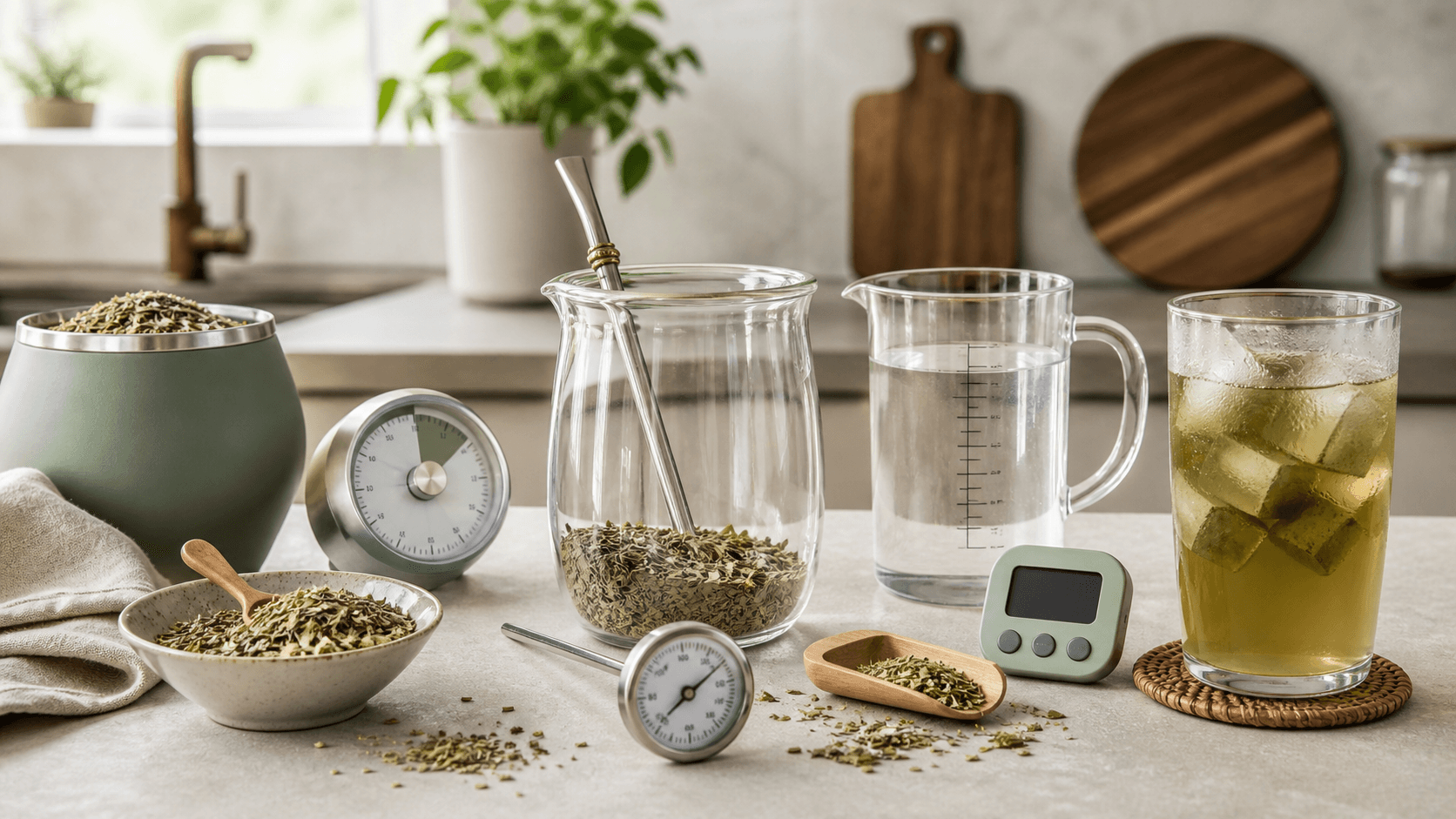
A yerba mate caffeine estimate can look precise while leaving out the details that make the number useful. The exact product, dry amount, water, brewing conditions, repeated infusions, dilution, and finished serving can all matter. So can the source of the number.
That is especially important for homemade frozen mate cubes. A cube count is a portioning method, not a caffeine test. Until a batch has a defined recipe, measured cube volume, and evidence tied to that exact preparation, the caffeine per cube is unknown.
This guide does not calculate a universal amount. It shows what needs to stay attached to any estimate before you use it to describe a drink.
The short version
Use an estimate only when you can answer three questions:
1. What exact material or product was measured?
2. How was it prepared, and what finished amount does the result describe?
3. Does the evidence come from this product or batch, or from a different sample?
If one of those answers is missing, label the result incomplete or unknown. Do not fill the gap with a category average.
Variables to record before using a number
| Variable | What to record | What it does not prove by itself |
|---|---|---|
| Product identity | Brand, lot or batch when available, leaf-and-stem format, or exact packaged product | That another mate product has the same caffeine content |
| Dry amount | Grams of mate or the package's defined portion | The caffeine in a finished drink without preparation evidence |
| Water | Volume used for the brew and any later dilution | The amount extracted from the dry material |
| Temperature | Measured brew temperature or a clearly described cold method | That hotter or colder is universally stronger |
| Time | Steep time or the timing of repeated pours | A caffeine value without a result tied to that method |
| Infusions | Single steep, repeated pours, or combined extractions | That one infusion describes the total from a multi-pour routine |
| Finished volume | Liquid after straining, ice, milk, or added water | The caffeine concentration unless caffeine was measured or disclosed |
| Frozen portion | Tray cavity volume, batch yield, and cubes used | Milligrams per cube |
| Evidence | Current product label, direct batch analysis, or a study with matching details | Permission to transfer a result from a different product or method |
The point is not to make home preparation feel like a laboratory. It is to keep the denominator visible. A number per gram of dry mate, per measured infusion, per bottle, and per finished glass each describes a different basis.
Two studies, two different evidence packages
The safest way to read brewing research is to keep the method beside the result. These two 2024 studies both measured caffeine, but they did not test the same products or preparations.
| Method field | Single- and double-brewing study | Hot- and cold-preparation study |
|---|---|---|
| Material | Three commercial yerba mate samples with visibly different proportions of leaves, twigs, dust, and particle sizes | Thirteen purchased products: pure yerba mate, yerba mate with additions, and one separate *Ilex guayusa* product |
| Dry amount and water | 5.0 g dry sample with 100 mL distilled water | 1.0 g sample with 25 mL distilled water |
| Temperature and time | 70 C or 100 C for 10 minutes, covered | Final comparison used 80 C or 3 C for 10 minutes after a separate optimization stage |
| Infusion count | First infusion, then the retained material was brewed a second time under the same conditions | One extraction for the final product comparison |
| Separation | The clear infusion was filtered before analysis | Paper filtration, followed by additional dilution and syringe filtration for LC-MS/MS analysis |
| Analytical method | HPLC with external standards | LC-MS/MS with external standards |
| Reporting basis | Caffeine reported against dry matter | Caffeine reported as concentration in the prepared extract |
| Finished consumer serving | Not defined as a home serving, packaged drink, or frozen cube | Not defined as a home serving, packaged drink, or frozen cube |
This matrix is a source map, not a recipe. The temperatures and ratios describe the researchers' experiments; they are not recommended preparation instructions.
The studies support one narrow conclusion: “yerba mate” is not one standardized material or preparation. They do not supply a caffeine value for an untested homemade batch, a future Yerba Melt cube, or every hot or cold drink. They also should not be turned into a universal hot-versus-cold rule. Product identity, particle composition, dry amount, water, time, temperature, repeated extraction, filtration, analytical method, and denominator all need to travel with the result.
The second study also shows why identity checks matter. Its sample set included products with fruit, herbs, guarana, or other additions, plus one product made from *Ilex guayusa* rather than *Ilex paraguariensis*. A result from one of those samples cannot silently stand in for plain yerba mate.
A label value is useful when the serving stays attached
For a packaged drink that discloses caffeine, record the exact product and the portion covered by the statement. The FDA notes that caffeine amounts can vary among products and container sizes. That makes the product name and covered portion part of the claim, not optional context.
Use this transcription table before comparing packaged mate with another drink:
| Label field | What to copy exactly |
|---|---|
| Product | Full product and variety name |
| Container | Total volume in the package |
| Serving size | Household measure and metric amount when shown |
| Servings per container | The stated count |
| Caffeine statement | Amount, unit, and the portion it covers |
| Preparation | Ready to drink, concentrate, or directions for mixing |
| Date checked | When you read the package or current manufacturer page |
If the product does not disclose a caffeine amount, write “not disclosed” or “unknown.” It does not mean zero, and a number from another label does not repair the missing field. The caffeine disclosure worksheet provides a fuller side-by-side version.
Why homemade cubes need a batch record
Freezing prepared mate does not create a caffeine measurement. It divides a brewed batch into frozen portions.
For a repeatable batch, record:
| Batch field | Example of the kind of note to keep |
|---|---|
| Mate | Exact product and measured dry amount |
| Brew | Water volume, temperature, time, and infusion count |
| After brewing | Strained or combined liquid volume |
| Tray | Cavity volume and number of filled cavities |
| Serving | Cube count plus the liquid added to the glass |
| Caffeine evidence | Product-specific disclosure or direct analysis, if one exists |
This record can make the kitchen routine more consistent, but consistency is not the same as chemical analysis. If the caffeine evidence field is blank, keep the milligrams-per-cube field blank too.
For help recording the physical portion, use the cube size and dilution worksheet. For a fair two-method tasting setup, see cold-brew cubes versus hot-brew cubes.
Separate what you know from what you are estimating
| Evidence level | What you can say | What remains unknown |
|---|---|---|
| No product disclosure or batch test | The drink contains yerba mate and therefore contains caffeine | The milligrams in the cube or finished glass |
| Current label tied to an exact serving | The disclosed amount for that labeled product and portion | A homemade batch or a different product |
| Study result tied to a defined sample and method | What researchers measured under those conditions | A consumer serving prepared another way |
| Direct analysis of a defined batch | The result for that tested sample and analytical basis | A changed recipe, batch, cube size, or serving unless separately supported |
This distinction keeps a useful observation from becoming a product claim. It also avoids false precision: multiplying an uncertain category number by a carefully measured cube volume still produces an unsupported estimate.
A practical pre-publish check
Before repeating a caffeine number in a recipe, comparison, or label walkthrough, ask:
- Is the exact product or sample named?
- Is the dry amount or labeled serving defined?
- Are the water, time, temperature, and infusion method available when they matter?
- Is the finished volume clear?
- Does the number come from this product or preparation?
- Have dilution, ice, milk, and cube count stayed separate from the caffeine evidence?
- Are unknown fields still marked unknown?
If the answer to any material question is no, explain the limitation instead of forcing a calculation.
The cold yerba mate caffeine guide applies the same discipline to chilled drinks. The yerba mate label-reading guide can help with packaged products.
For Yerba Melt, the right path is straightforward: define the final formula and serving, test the actual product, and write the label around that evidence. Until then, a universal caffeine-per-cube number would be a guess.