Best equipment for cold yerba mate: choose by method
A practical cold yerba mate equipment checklist for choosing a gourd and bombilla, jar, pitcher, strainer, or freezer container by the method you actually use.
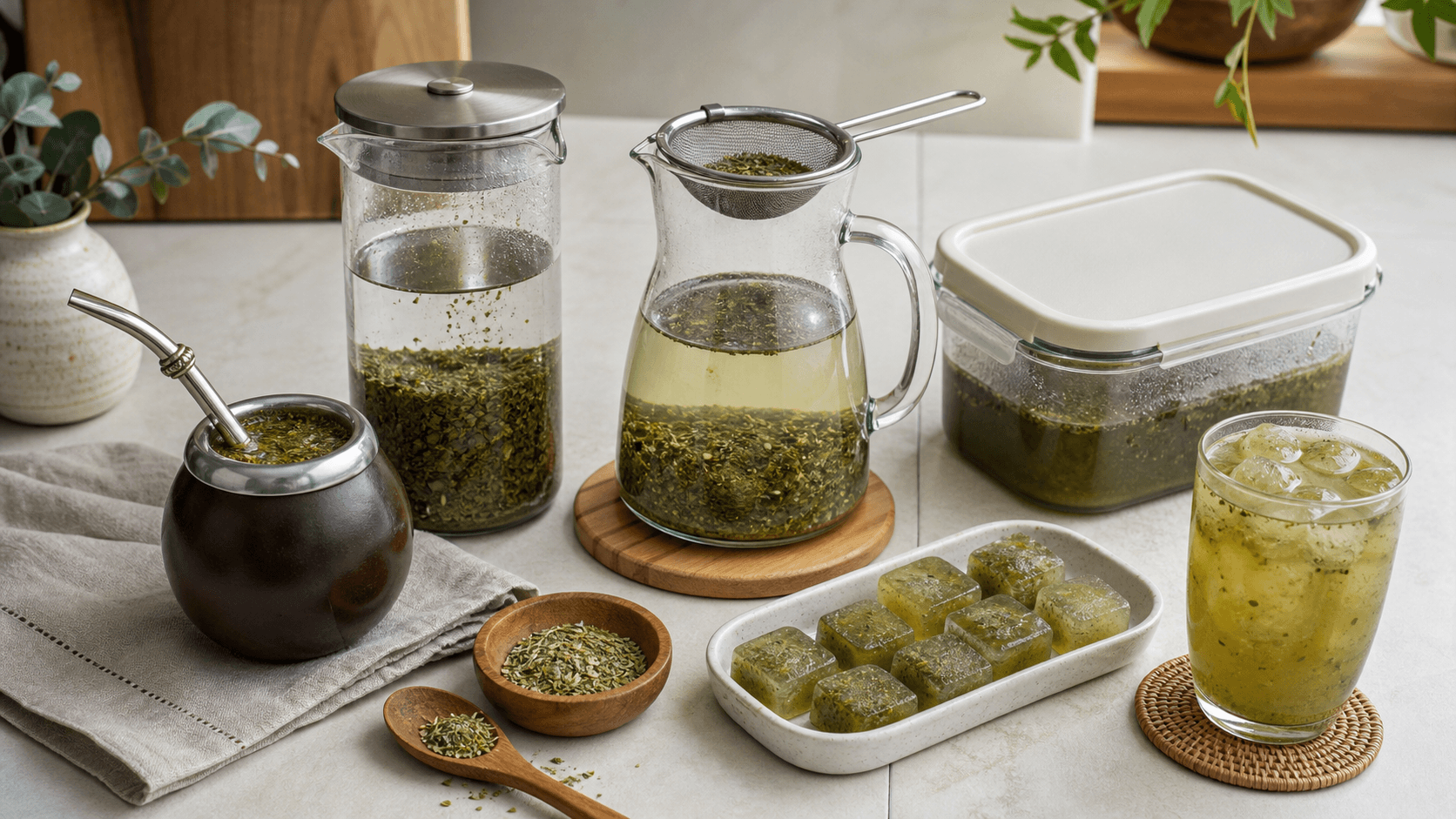
The best equipment for cold yerba mate is the equipment that fits the method you will actually make. A gourd and bombilla serve a different routine from a covered refrigerator jar, and both are different from a pitcher of strained mate or a container of frozen portions.
This guide is a selection checklist, not a ranked shopping list. It uses one current manufacturer page only to show the kinds of specifications worth checking. Brand, price, and popularity do not make an item universally best.
Choose the method before the gear
| If you want to… | Start with | Check before buying |
|---|---|---|
| Sip mate through the leaves | A mate vessel and bombilla | Vessel opening, straw length, filter shape, material, and stated care instructions |
| Make a refrigerator batch | A covered jar or pitcher | Capacity, lid fit, refrigerator footprint, material, and easy access for cleaning |
| Strain a loose-leaf batch | A pitcher plus fine-mesh strainer | Mesh fineness, stable handle, bowl diameter, and whether it sits securely over the receiving vessel |
| Pour a simple iced glass | A heat-appropriate brewing vessel, pitcher, and glass | The maker's temperature guidance, pouring control, capacity, and cleaning instructions |
| Freeze prepared mate | A stable tray and covered freezer container | Freezer suitability, leak resistance, room for expansion, lid fit, and easy marking |
One setup can cover several jobs, but it helps to name the daily task first. Buying a traditional-style vessel does not remove the need for a refrigerator container if your real routine is batch cold brew.
Gourd and bombilla: check fit as a pair
A bombilla is a filter straw used to sip mate while holding back most of the leaf material. For cold preparation, the useful questions are physical:
- Does the straw length fit the vessel?
- Does the filter sit where you expect when the vessel is filled?
- Does the maker state the material and care method?
- Can you inspect and clean the filter form?
- Is the vessel stable and comfortable to hold?
As one current specification example, Stanley lists its bombilla as 18/8 stainless steel with a perforated spoon filter and says it is dishwasher safe. The page lists a 7.44-inch length and 0.86-inch width. Those details describe that product as accessed July 25, 2026; they do not establish that it is the best bombilla or that it fits every vessel.
If you are exploring terere, keep the equipment in its cultural context. The terere, iced mate, and cold brew comparison explains why a cold-mate product format should not be presented as a replacement for a traditional practice.
Jar or pitcher: make the batch easy to repeat
For refrigerator cold brew, a useful container is covered, easy to clean, and large enough for the water and leaves without being awkward on the shelf.
| Field | What to record |
|---|---|
| Working capacity | The actual water amount you plan to use, with space left for leaves and stirring |
| Lid | Whether it closes securely and is easy to remove |
| Shape | Whether a brush or hand can reach the bottom and corners |
| Pouring | Whether the batch pours cleanly before or after straining |
| Refrigerator fit | Height and footprint on the shelf you intend to use |
Do not infer freezer suitability from the fact that a jar works in the refrigerator. If a manufacturer does not identify a glass container as intended for freezing, use a different freezer-rated container.
The cold brew yerba mate guide has a refrigerator-first worksheet for leaf, water, steep, straining, dilution, and taste.
Strainer: match the mesh to the leaf
A strainer is useful when the finished drink should leave the loose mate behind. Fine cuts and dust need a finer filter than large leaf pieces.
Look for:
- mesh fine enough for the product you use
- a rim or handle that sits steadily over your pitcher
- enough capacity that the leaves do not spill over
- a shape you can rinse and inspect
- maker care instructions that fit your kitchen routine
A clogged fine mesh can pour slowly, while an open mesh may leave more particles in the drink. That is a preference and workflow tradeoff, not a quality ranking.
Freezer equipment: use criteria made for freezing
The National Center for Home Food Preservation says freezer containers should resist moisture vapor, be durable and leakproof, avoid becoming brittle at low temperatures, protect the contents, and be easy to mark. It also advises using containers that fit the product and a tight cover.
For liquids, expansion matters. NCHFP guidance says to leave adequate headspace between the contents and closure so the food can expand as it freezes. Its container guidance distinguishes wide-mouth glass jars made for freezing from regular glass jars, which can break more easily at freezer temperatures.
Translate that into a cold-mate checklist:
| Check | Why it matters |
|---|---|
| The maker identifies the container for freezer use | Refrigerator-safe and freezer-safe are not interchangeable claims |
| Space remains below the closure | Prepared mate expands as it freezes |
| The lid closes tightly after freezing | A covered batch is easier to organize and protect |
| The container can be labeled | Date, brew, cube size, and tasting notes make a batch repeatable |
| The tray or container sits flat | Liquid mate is easier to move without spills |
This is container-selection guidance, not a tested storage-life promise for homemade mate cubes. The tray and freezer-container guide goes deeper on cube size, lids, and labeling.
A five-minute equipment audit
Before adding another tool, put your current setup on the counter and answer five questions:
1. Which cold-mate method am I making?
2. Which step is awkward: steeping, filtering, pouring, storing, or cleaning?
3. Does the equipment fit the amount I actually prepare?
4. Can I verify the material, care instructions, and temperature or freezer use from the maker?
5. Will the setup be easy enough to use again next week?
If the current jar, pitcher, and strainer already pass that audit, you may not need special equipment. If the daily friction is brewing, cooling, portioning, and cleanup, a ready-made frozen cube would solve a different problem than a new vessel.
That is the Yerba Melt product question: which part of cold mate should arrive already handled, and which serving ritual do people want to keep?