An office freezer routine you can measure honestly
A blank desk-to-glass task card for testing frozen yerba mate cubes at work without inventing a time-saving, caffeine, shelf-life, or productivity claim.
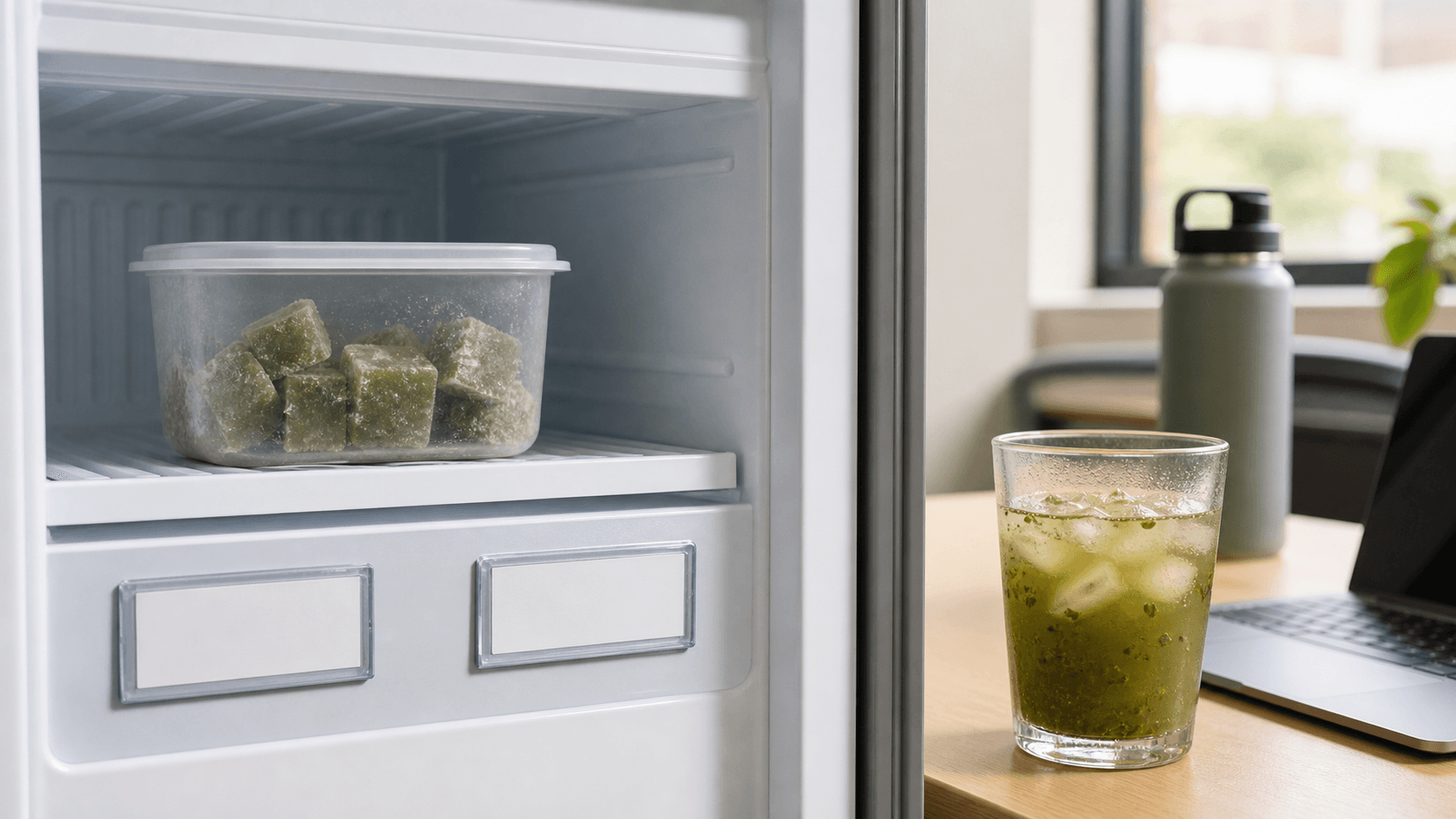
An office freezer sounds like an obvious home for frozen yerba mate cubes: keep a covered batch at work, add a measured liquid, and finish the drink at your desk. But an attractive routine is not the same as a tested one.
This guide is a blank desk-to-glass task card. It helps you observe one setup without claiming that cubes save a certain number of minutes, improve productivity, provide a known caffeine amount, or stay at their best for a particular length of time.
It also is not a workplace food-safety policy. Follow the rules for your shared appliances and use the routine at home if the office setup is not suitable.
Check the setup before starting
The FDA says a freezer should be kept at 0 F (-18 C), checked periodically with an appliance thermometer, and not packed so tightly that air cannot circulate. Its storage guidance also recommends covered containers. Those are useful controls, but they do not establish a mate-cube shelf life or prove that one batch remained at the recommended temperature.
Record what you can actually verify:
| Setup field | What to record | Leave unknown when |
|---|---|---|
| Freezer | Appliance reading and time checked | No thermometer reading is available |
| Container | Material, lid or closure, and where it sits | The container or closure is not identified |
| Batch | Label or batch name and date made | The batch cannot be matched confidently |
| Cube | Count plus a size, mass, or tray reference | The cubes are not comparable |
| Starting liquid | Type and measured volume | The pour was not measured |
| Vessel | Glass, mug, or bottle identity | Different vessels were mixed together |
Do not substitute appearance, odor, or a still-frozen cube for a recorded freezer temperature. FDA specifically notes that food can present a safety risk even when it does not look, smell, or taste spoiled.
Define the task before timing it
NIST's Metric Kitchen guidance recommends consistent measurement for repeatable results and suggests checking a timer against another timer or clock before relying on it. For this informal routine, define the start and stop before you touch the container.
A start rule might be “hand touches the freezer handle.” A stop rule might be “drink is at the desk and the container, counter, and spoon are put away.” Those are examples of boundaries, not measured results.
Use the same boundaries each time:
| Task boundary | Your definition |
|---|---|
| Start | ______________________________ |
| Stop | ______________________________ |
| What counts as cleanup | ______________________________ |
| Where the drink must finish | ______________________________ |
| Timer checked against | ______________________________ |
If a colleague asks a question, the sink is occupied, or you return for a forgotten spoon, keep that interruption in the record. A selectively timed best case is not a representative routine.
Use a blank desk-to-glass task card
Complete the card during or immediately after one attempt. Repeat it on different days before summarizing anything.
| Observation | Entry |
|---|---|
| Date and local time | ______________________________ |
| Batch and container | ______________________________ |
| Freezer reading and check time | ______________________________ |
| Cube count and size reference | ______________________________ |
| Starting liquid and volume | ______________________________ |
| Vessel | ______________________________ |
| Start rule and timestamp | ______________________________ |
| Stop rule and timestamp | ______________________________ |
| Interruptions or extra trips | ______________________________ |
| Finished volume | ______________________________ |
| Cleanup included | ______________________________ |
| Remaining cubes returned and container closed | ______________________________ |
| Taste or dilution note | ______________________________ |
| What should stay the same next time | ______________________________ |
| One variable to change next time | ______________________________ |
This card deliberately has no suggested time, default cube count, preferred dilution, or “good” result. Those values depend on the actual batch, tray, liquid, freezer, vessel, and person doing the task.
Compare attempts without overselling them
After several complete cards, line up only attempts that used the same start rule, stop rule, batch, cube reference, starting liquid, and cleanup boundary. Keep interruptions visible.
| You can report | You cannot infer from this card |
|---|---|
| What happened in the recorded setup | A universal preparation time |
| Which step caused an extra trip | Guaranteed time savings |
| Whether the container was closed and returned | A product shelf life or safety guarantee |
| The measured finished volume | Caffeine per cube or per glass |
| A taste or dilution observation | Energy, focus, or productivity outcomes |
If the setup changes, start a new comparison rather than blending unlike attempts into one number.
Keep caffeine separate from convenience
Yerba mate contains caffeine, but the task card cannot determine how much is in the finished glass. Cube count, color, bitterness, melt time, and finished volume do not supply a caffeine measurement.
For a homemade batch, keep the note descriptive: identify the mate, brew record, cube reference, and amount used. If an exact caffeine value is not available from an applicable label or product-specific analysis, leave it unknown.
Decide whether the routine fits
The useful question is not “Are cubes faster?” before anyone has measured them. It is “Can this exact container-and-glass routine be repeated without missing steps or creating friction?”
If the freezer lacks a temperature reading, the container cannot be closed, the batch is not identifiable, or workplace rules do not allow the setup, record that result and stop. A failed fit test is useful evidence.
For related measurement tools, use the cube-size and dilution worksheet. For the broader format, see what frozen yerba mate means.
If an office freezer is where you would actually test the format, join the waitlist and tell us what your real setup looks like.